Can Baby Sleep on My Chest if I'm Awake
Decision-making is a crucial attribute of becoming a parent. New parents accept to deal with numerous tough decisions, and ane of them would be whether or not to allow your baby slumber with you. Y'all might take already decided your babe'due south identify of sleep, but some babies might insist on sleeping with you!
Ringlet through any social media feed, and you're bound to run across at least one adorable motion-picture show of a newborn-parent duo snoozing breast-to-chest. As a new mom, nosotros love property my babes close, feeling their tiny hearts chirapsia in tandem with ours. There's no incertitude this creates a sacred bond with your baby—but is it condom?
At that place's a lot of confusion virtually sleep safety when it comes to newborns. Let's become over the most common questions and so you tin make the all-time choice for your family.
Looking for infant nursery chairs ? Expect no further. My Baby Nursery have an all-encompassing list to cull from.
Should Infants Be Allowed to Sleep on Your Chest?
Newborn babies should not be allowed to sleep on your chest because this increases the chances of tragedies similar SIDS. It is best to constitute a dominion of not letting your babe sleep on your chest. Letting your baby sleep on your breast, or co-sleeping might seem similar a very skilful way for yous to bond with your child, merely it can exist dangerous. Y'all might exist rocking the babe to sleep, but as soon as you lot lay him, he might wake upwardly. This is why many people let them fall comatose on their chest or co-sleep, but information technology can be really unsafe for the babe. Apart from increasing the risk of Sudden Infant Death Syndrome (SIDS), it also increases the risk of accidents or suffocation.
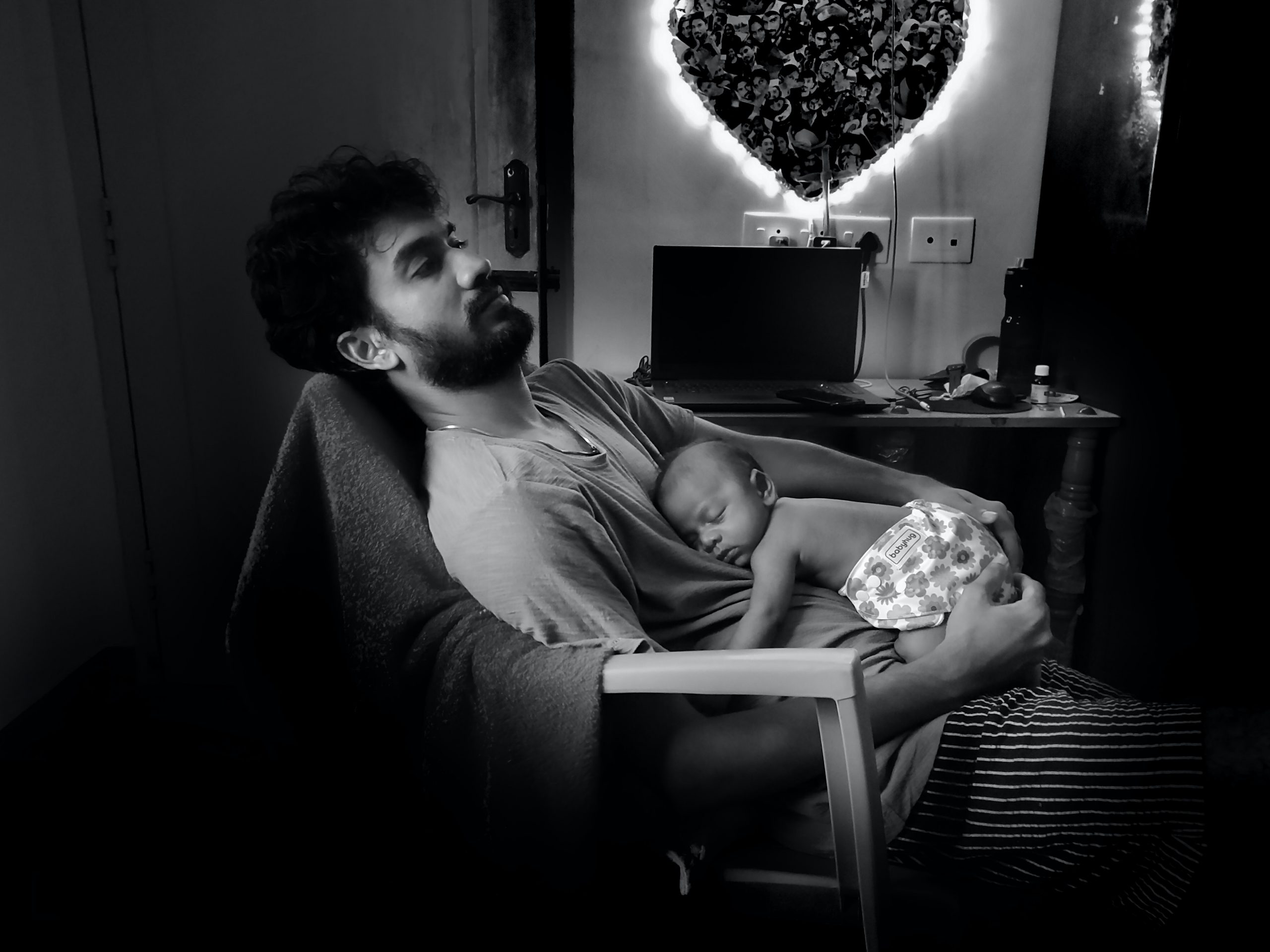
Is it Safe to Sleep With My Baby on My Chest?
Holding your babe skin-to-skin is such a powerful bonding feel that it's recommended by the American Academy of Pediatrics (AAP) for up to an hour subsequently birth. Beyond this fourth dimension, it's still considered safe with one exception—you lot must be awake. The AAP warns that falling asleep while your infant is sleeping on yous greatly increases the hazard of sudden infant death syndrome (SIDS).
How and Where Should a Newborn Sleep?
According to the AAP, the safest place for newborns to slumber is on a house surface in their parent's sleeping accommodation. To reduce the risk of SIDS, babies should e'er be placed on their backs to slumber. Cribs, bassinets, portable cribs, and play yards are all recommended as long as they are free from soft objects similar bedding, bumpers, blankets, and toys.
What Can You Do If Your Baby Wants to Sleep on Your Chest?
Swaddling
You should try swaddling your infant if you had non already done this before. He was living in your womb for and so many months that he is used to the snug and comforting feeling. Wrapping your baby or swaddling him will help replicate that amazing feeling, which will help your baby sleep well.
Dock-a-Tot
Some babies detect the crib to exist 'vast' to slumber properly. This could be another reason why infants adopt sleeping on their parent'southward breast. For many families, bed-sharing or co-sleeping might is an choice, and y'all can use a Dock-A-Tot, an in-bed co-sleeper to assist your babe sleep with you lot safely. This fashion, you will be able to share your bed safely with your infant.
Cypher a dee-Zilch
If your baby is more four months former or if swaddling the baby is not working, then you could try using a swaddle transition product like Zipadee-Zip. This is useful when the babe'southward Moro reflex is still potent.
Rock-N-Play
Many families try this 'Rock-N-Play' method when their babies are young. If the baby is younger than four years old, then this method might be actually helpful for you. Nevertheless, in that location are chances that your baby might face problems later since he volition be accustomed to sleeping using the Rock-North-Play technique. Just note that this method is not considered to be the safest of all the other sleep surfaces since it is non flat and firm. You should check with your doctor if you experience similar there is not enough space for the baby to sleep.
Heartbeat While Noise
The sound of your heartbeat might exist one of the reasons your baby might like to sleep on your chest. If it is the mom's breast the baby is sleeping on, then it was your heartbeat the babe listened to for many months. So, you could consider using the white noise motorcar that has the heartbeat sound. This might not be the ultimate miracle solution, but it might help to a certain extent.
Sleep Training
If your babe is older than four months, then you could try sleep training him. You lot babe will be capable of sleeping on another surface since he does not know the deviation or that there is something wrong with it. Many babies demand to learn how to sleep well independently in other spaces.
It is brash not to co-sleep or let your infant sleep on your breast if either yous or your partner smoke or swallow booze. You should not practice information technology even when you are extremely tired or if the babe was born prematurely. Information technology is best to make him sleep in a crib without any blankets or pillows, so the run a risk of suffocation is reduced. The all-time way for parents who desire to be with their babies while sleeping is to slumber in the same room with them. Place the crib abreast you and so that he is about you, and this way, you are also decreasing the chances of SIDS.
Helping Babies Sleep Safely
Are you expecting or caring for a baby? Take these steps to assistance baby slumber safely and reduce the take a chance of slumber-related infant deaths, including sudden infant death syndrome (SIDS).
There are well-nigh 3,500 slumber-related deaths amongst US babies each yr. CDC supports the updated 2016 recommendations for external icon issued past the American University of Pediatrics (AAP) to reduce the adventure of all sleep-related infant deaths, including SIDS. Come across How to Keep Your Sleeping Baby Safe: AAP Policy Explained External icon to learn more than about these and other actions.
Parents and caregivers tin can help create a safe sleep surface area for babies by taking the following steps:
- Place your baby on his or her dorsum for all sleep times—naps and at night. Even if a infant spits up during slumber, babies' anatomy external icon and gag reflex help prevent them from choking while sleeping on their backs. Babies who sleep on their backs are much less likely to dice of SIDS than babies who sleep on their sides or stomachs.
- Utilize a firm, flat sleep surface, such equally a mattress in a safety-approved crib external icon covered merely by a fitted sheet. Some parents and caretakers might feel they should place their baby on a soft surface to help them exist more than comfortable while sleeping. Nonetheless, soft surfaces tin can increase the risk of sleep-related decease. A business firm slumber surface helps reduce the risk of SIDS and suffocation.
- Keep your baby'due south sleep surface area (for instance, a crib or bassinet) in the same room where you sleep until your baby is at to the lowest degree 6 months former, or ideally until your infant is i year old. Adventitious suffocation or strangulation can happen when a baby is sleeping in an adult bed or other unsafe slumber surfaces. Sharing a room with your infant is much safer than bed sharing and may subtract the take chances of SIDS by equally much equally 50%. Placing the crib shut to your bed so that the baby is within view and reach can also assist brand information technology easier to feed, condolement, and monitor your baby.
- Keep soft bedding such as blankets, pillows, bumper pads, and soft toys out of your baby'south slumber area. Additionally, do non cover your baby's head or let your baby to become as well hot. Some parents may experience they should add sheets or blankets to their baby's crib to help keep their infant warm and comfy while sleeping. Even so, sheets, comforters, and blankets tin can increase the risk of suffocation or overheat your infant. If you lot're worried well-nigh your baby getting cold during sleep, you can dress them in sleep habiliment, like a vesture coating. In a contempo Pediatrics report external icon, CDC scientists and colleagues plant that baby suffocation deaths during sleep were nigh frequently due to soft bedding, such as blankets and pillows.
Babies should sleep in a bare crib.
An astounding 73 per cent of moms in our survey say they take placed at to the lowest degree one item within the crib with their infant. A blanket was nigh common (59 per cent), followed by bumpers (35 per cent), stuffed animals (23 per cent), and pillows (eight per cent). All are suffocation hazards for babies one and younger and can increase the risk of SIDS upwards to five times, regardless of Baby's sleep position, reports the American Academy of Pediatrics (AAP).
Moms sometimes get a mixed bulletin. "When women walk through a infant store or flip through a catalogue or magazine, they see bumpers, blankets, and stuffed animals, and they recollect they need to buy them to be proficient parents.
When setting up your little one's crib, always remember that bare is best. The only thing you should have in the crib is a fitted sheet. No pillows, no stuffed animals, no sleep positioners or slumber wedges (they pose the aforementioned suffocation hazards as pillows), and no crib bumpers, which have been linked to suffocation and strangling of infants.
Always put your baby down to sleep on her back.
20-eight per cent of moms say they have put their baby to sleep on his stomach, a practice that leaves babies at increased risk for SIDS. And of those who accept this risk, 47 per cent practise it before their infant turns three months old. That's when the take a chance of SIDS is highest, in the first four months, associate director of the Sleep Centre at the Children's Infirmary of Philadelphia and author of Sleeping Through the Dark.
Many of these parents are what we'd phone call "conscientious objectors. They think that what they're doing is somehow ameliorate or safer than what their pediatrician is telling them." Parents who are desperate not to hear their baby weep, for example, may find means to rationalize stomach-sleeping. It'due south true, and babies do wake up more hands when they're on their back. Merely that may protect them from SIDS. Infants who sleep on their stomach don't arouse as well, which means they can get in trouble with their oxygen levels and never wake up."
Another common justification for stomach-sleeping (for 10 per cent of the dominion-breakers) was worry that Baby would choke from reflux. No evidence supports this. Stomach-sleeping is riskier than back-sleeping when it comes to choking concerns.
To ensure safe sleep for babies, make back-sleeping not-negotiable. "The only fashion you're going to teach your baby to sleep on his back is to teach your baby to slumber on his back. It's the same thing as an babe who hates to be in his car seat. He has to be in his car seat.
Finding the correct northward ursing chair for your baby nursery is an of import decision. Check out our range of the best nursing chairs at My Babe Nursery.
Exist careful with co-sleeping.
Co-sleeping, defined as sleeping on the same surface with Baby, is common, Dr Mindell says. Threescore-five per cent of the moms we polled have slept in bed with their infant, and of those, 38 per cent practise so regularly. The majority of these bedsharing moms worry near their baby's run a risk of accidental suffocation, but they exercise it anyway. Why? To help their child sleep, to make nursing easier, to bond with Babe, and because Infant won't sleep anywhere else, they say.
Just bed-sharing is perilous. Studies show that about half of all suffocation deaths amidst infants happen in an adult bed. Compared with sleeping in a crib, the overall death rate is more than than 40 times higher for babies who slumber with a parent. There are multiple dangers in an adult bed that can suffocate Baby, from a less-house mattress and big pillows to fluffy comforters and actress blankets. Parents likewise mistakenly believe they're light sleepers and would wake up if they rolled over on their babe, simply that's not the case in and then many tragic instances.
The safest option is putting Baby to sleep in a portable crib in your room. Then, when she's used to that, movement her to a crib in her room. Not only will she be safe, she'll snooze more than securely. "In one study I conducted, we found that babies who sleep with Mom and Dad wake up twice every bit often than when they sleep lonely. They don't larn to soothe themselves, and that'due south what keeps them upwards.
Never slumber on the couch with your babe.
A staggering 53 per cent of moms in our poll report they share the couch with their baby, a number that astonished our experts. Information technology's by far the well-nigh dangerous choice considering couches can exist softer and plusher than an adult bed, and Mom or Dad could accidentally roll over and suffocate Baby. Ironically, some parents think couch-sharing is relatively safe because if they put Baby between their body and the dorsum of the couch, she can't fall off equally she could in a bed. In reality, the kid can become trapped between the parent's trunk and the couch, and that can be much more than dangerous.
As a rubber upgrade, bond with your babe before bed, and and so put her in her crib. When y'all're wiped out or if it'southward nighttime, avoid nursing or feeding your babe on the burrow. You're more apt to doze off at that place than in a less comfy spot. If your sweetie falls asleep and you're tempted to snuggle her while you lot scan your Netflix queue, think twice.
Finally, never place a sleeping baby on a burrow. Virtually 18 per cent of moms say their babe has slept on a couch solitary, but even if you're awake, it'due south never safe. It takes merely a minute for suffocation to occur.
Follow these slumber guidelines for naps, besides.
As nosotros pored through the comments in our study, i thread stood out: Many moms who wouldn't dream of putting their infant on his stomach at dark do so at naptime. "Parents think that since they're up and most, they're watching their baby. Only the reality is, you're in the kitchen, yous're on the figurer, and if your infant is having a hard fourth dimension breathing, information technology's silence."
Research also shows that a infant who is used to sleeping on his back only is periodically put on his abdomen to snooze is eighteen times more probable to dice from SIDS. Experts aren't sure why, but i theory is that babies who nod off on their back well-nigh of the time develop motor skills differently and can't lift their caput as easily when they're on their stomach, which puts them at risk for asphyxiation.
Where's the Safest Place for Your Infant to Sleep?
Ask anyone how much sleep you're likely to become after your baby is born, and they'll all tell you the aforementioned affair: "Not much." But ask where your infant should slumber, and y'all'll probably get several different answers. Even professionals tin't concord. The American Academy of Pediatrics (AAP) advises parents not to take their babies with them to sleep at nighttime on the same sleeping surface (called "bed-sharing") due to the belief that this increases the risk of sudden babe death syndrome (SIDS). The AAP recommends that babies take a separate but nearby identify to sleep, such as a crib or bassinet in the parents' sleeping accommodation for at to the lowest degree the first 6 months and, optimally, for the commencement year. No research is bachelor to support the notion that it'southward safer for babies to sleep lone, or that those who do become more independent than babies who sleep with their parents.
Pare-to-Skin & Rooming In
Since the commencement of time, parents have needed and wanted their new babies close to them. Today nosotros know that this yearning for closeness is a physiological need shared by you and your baby. Studies have shown that newborns who are placed skin-to-skin on your chest right after birth will adjust more hands to life outside the womb, stay warmer, cry less and breastfeed sooner than if your babe is separated from you.
The AAP and Lamaze recommend peel-to-skin care immediately following nascence for at to the lowest degree an hour as soon as you are medically stable and awake. Your baby must stay every bit close to you as possible in the days following birth also. Rooming-in with your baby on a separate sleeping surface, such as a bassinet or crib, allows you to learn your newborn's needs as well as how to best care for, soothe and comfort them. Rooming-in also offers the all-time showtime for breastfeeding. The nearer your baby is to you, the sooner you will brand more milk and the more likely you are to breastfeed longer and exclusively. (Experts recommend exclusive breastfeeding—no other foods or liquids—during the start six months of life.)
Check out our range of baby nursery rocking chairs at My Baby Nursery.
Prophylactic Sleep
It's newborn sleep safety that should business organisation you most. Always put your baby on their dorsum when y'all lay them downwards on a business firm surface. This is the all-time-known SIDS prevention tactic. Go on the bedroom at a temperature you find comfortable when lightly clothed, and dress your baby for slumber the same way. Overheating tin can exist dangerous. Their crib, bassinet or cradle should meet current safety standards and be free of soft bedding, crib bumpers, blankets and costly toys, which are suffocation hazards.
The safest identify for your baby to sleep? A identify near you. What's most important is that you and your baby are near each other and get some slumber.
Can Baby Sleep on My Chest if I'm Awake
Source: https://mybabynursery.com.au/is-it-safe-for-babies-to-sleep-on-your-chest/
0 Response to "Can Baby Sleep on My Chest if I'm Awake"
Post a Comment