Was Francis Bacon a Part of an Art Movement
The truth backside Francis Bacon'south 'screaming' popes
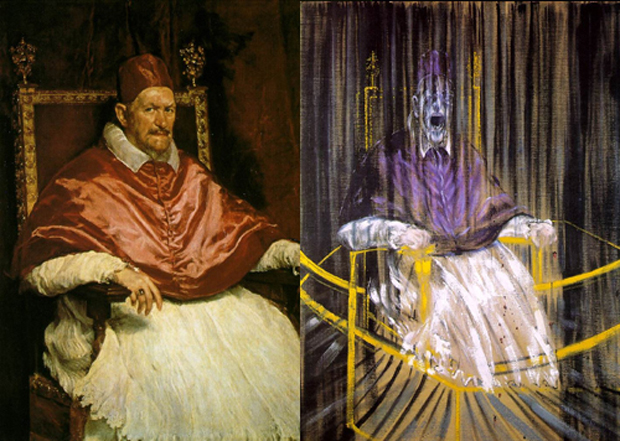
Begetter effigy, elevate queen or distillation of Nazi iconography? New Phaidon Focus book reveals the theories behind Francis Bacon'south obsessive reworking of the papal theme in his most famous Velasquez-inspired paintings
Effectually this time last week nosotros brought you a look within Anselm Kiefer'south studio every bit function of a sneak preview from a Phaidon Focus book we're publishing on the acclaimed High german artist. Today our Phaidon Focus is on a serial of Francis Bacon'due south most famous paintings inspired by Velasquez'due south Pope Innocent X portrait. Scholars take pored over the paintings and the possible inspirations behind them e'er since Bacon painted them in the 1950s.
Bacon worked on his pope paintings, variations on Velázquez'southward magnificent portrait of Pope Innocent X, for over 20 years. He was already exploring the thought while in the South of France in late 1946. The beginning surviving version (Head VI) dates from late 1949, and he finally stopped in the mid-1960s. Subsequently, Salary announced that he thought the works 'silly' and wished he had never washed them. He acquired countless reproductions of the Velázquez painting from books, but famously did not run into the original when he visited Rome in tardily 1954.
Conspicuously Bacon was not just producing homages to a picture he loved. Artists take always made copies as creative exercises, and Bacon may accept been specially inspired by the instance of Vincent van Gogh (1853–1890), who made many transformations of pictures that he especially admired by Eugène Delacroix (1798–1863), Jean- François Millet (1814–1875) and others. Salary's popes depart even further from their source, often replacing the pontiff'due south head with the as recognisable screaming face of the wounded nurse mown down by the soldiers' gunfire in the Odessa steps sequence of Eisenstein'southward film Battleship Potemkin.
{media1}
The insertion subverts the encapsulation of power and self-assurance projected by Velázquez. The screaming mouth, isolated from other facial features and divorced from whatsoever narrative context, suggests existential agony. The pathos of human vulnerability and loss of religion or confidence are accentuated by the precisely rendered space frames in many Salary images of popes, which make the figures register as 'enclosed in the wretched drinking glass capsule of the human individual', to cite the evocative phrase used by the philosopher Friedrich Nietzsche in The Birth of Tragedy (1872), one of Bacon's favourite books.
The papal theme may take had a more contemporary resonance for Bacon, given that he embarked on his variations in 1946 immediately after the completion of Painting, with its dense references to Nazi iconography. He may have been attracted to the Velázquez moving-picture show as an iconic distillation of power, which fabricated it such a vivid precursor to Fascist propaganda photography. In later works in the series, Bacon inserted references to photographs of the then pontiff, Pope Pius XII, a controversial effigy who was idea past some to have appeased the Nazis. A photograph of Pius on his throne, beingness carried from St Peter's, appears in one of Sam Hunter's 1950 studio montages, and was conspicuously the ground for some of the subsequent pope pictures.
{media2}
Bacon's obsessive reworking of the papal theme suggests that it may have possessed farther significance and perhaps psychological charge for the artist in relation to his sexuality. Information technology has been remarked that the Pope in official garb is in a sense the ultimate drag queen, or less literally that depictions of the Holy Male parent, known in Italy every bit 'il Papa', may encapsulate Bacon'southward traumatic feelings about his own male parent. The latter was a conventional, inflexible military human to whom the teenage Bacon had felt sexually attracted, as he recalled many years subsequently, but who brutally admonished and rejected him when he discovered his son's homosexual inclinations. Such speculations about the possible 'subconscious' content of the pope pictures involve perhaps a rather crude application of the methods of Freudian psychoanalysis. Once again it is neither altogether possible nor helpful to pin Bacon down.
The Phaidon Focus series is designed as a lively, authorititive and accessible introduction to the piece of work of the artists featured in the (initial) 6-strong series (Kim, the editor, is already hard at work on the next instalment). As the title suggests, each features special Focus sections that explore specific and important themes, series, pieces or events in each artist's career, so whether you're new to the artist or yous already know a bit y'all'll come away aware and, we hope, nourished. Take a look at the serial in the store.
Source: https://www.phaidon.com/agenda/art/articles/2013/february/08/the-truth-behind-francis-bacons-screaming-popes/
0 Response to "Was Francis Bacon a Part of an Art Movement"
Post a Comment